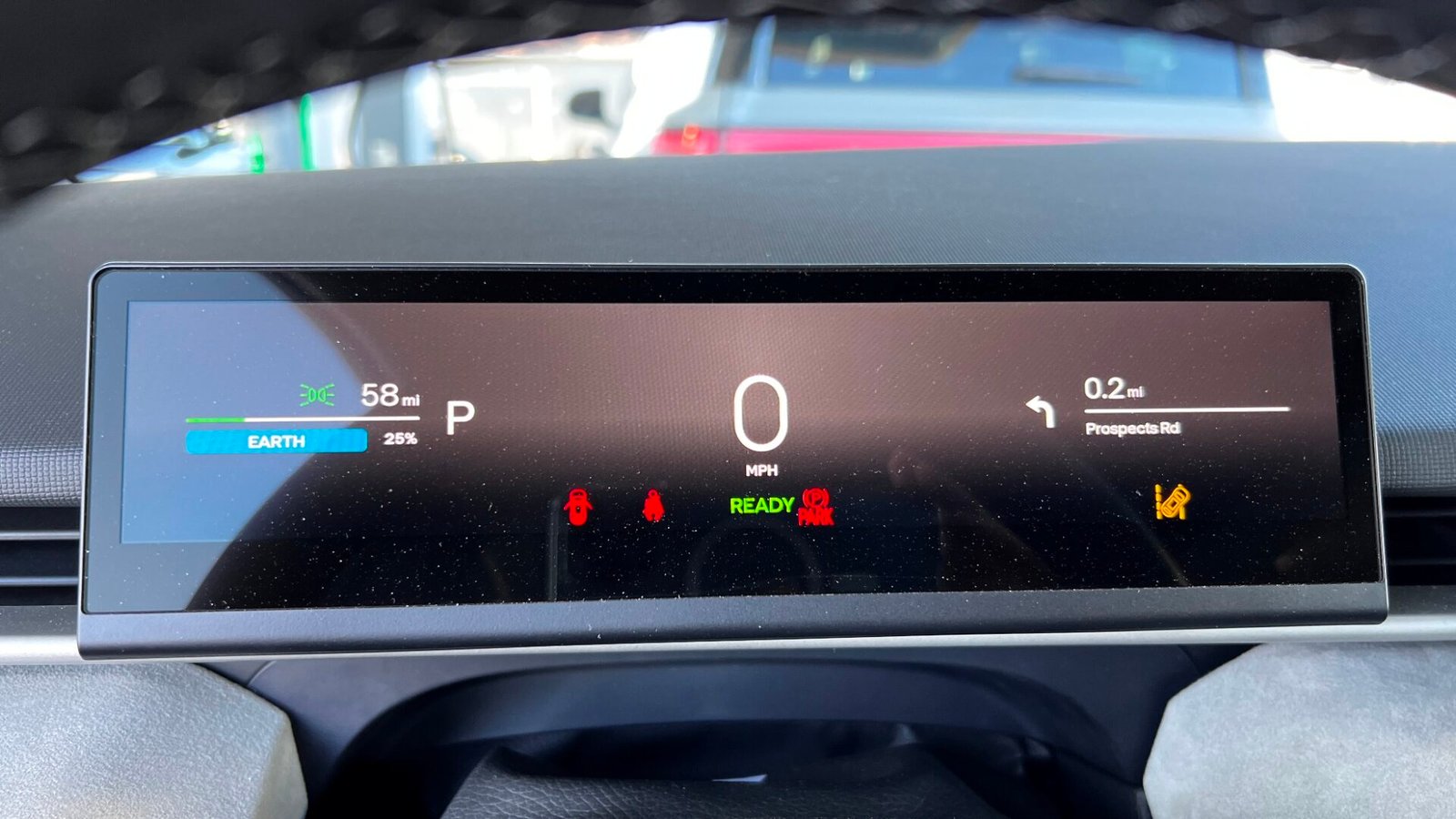

5 mph: The Art of the Coast
OK, so at first it seemed legit, and here was yet another Fisker fail point: The fact that the Fisker Ocean regen braking slows the car down to a point of 5-mph, then releases, never applying enough force to bring the car to a complete stop. Fisker forums and Reddit users are constantly crying out: “Where is our true 1-Pedal Drive?” For the uninitiated, the dream is simple—lift your foot off the accelerator and the car should regenerate power all the way down to a complete halt. No brake pedal required. Early on, I was right there with the protesters, feeling like I was missing out on a core EV experience because my Ocean would “give up” and start coasting once I dipped below that 5 mph threshold. Remember, I had the Polestar 2 for 3 years, so I was well aware of true 1-pedal driving.
But after thousands of miles behind the wheel, I’ve had an epiphany: I actually don’t want it. In fact, I’ve come to enjoy the “Fisker Stop.”
The Reality of the “Complete Stop”
We talk about 1-pedal driving as if our entire commute is a series of binary on/off movements. But have you actually looked at your driving data?
In real-world conditions, 99% of our driving happens above 15 mph. Think about your average trip:
- Turns: Making a right or left at an intersection? You’re likely doing that at 15–18 mph.
- Parking Lots: Navigating a Trader Joe’s lot is a steady 10–12 mph crawl.
- Stop Signs: Let’s be honest—the “California Roll” is a staple. Dropping to 5 mph at a four-way stop is already a cautious creep. At that speed, rolling through feels natural and fluid, and almost, too slow!
The truth is, the need for a total, dead-stop anchor only arises during the “Big Three”: drastic traffic jams, railroad crossings, and those interminable red lights.
Why I Prefer the Coast
There is a certain mechanical grace to how the Ocean handles low speeds. Instead of the car aggressively grabbing the rotors the moment you let off the gas, it lets you glide. It feels less like a golf cart and more like a sophisticated grand tourer.
I’ve started playing a game I call the Fisker Challenge. On my daily commute, I see how many times I actually have to touch the brake. The results? Usually, only 2–3% of my total slowdowns require me to physically hold the car.
When I do have to come to a full stop, it’s not an ordeal. A slight pressure on the pedal keeps the car stationary. Then, the light turns green, I ease off, and I’m gone. It’s a rhythmic, engaged way to drive that feels playful rather than fearful.
The “Nice-to-Have” vs. The “Must-Have”
Don’t get me wrong—full 1-pedal drive would be a cool software party trick. It’s a feat of engineering to blend regen and friction brakes so perfectly that the driver never knows which is which.
But is the lack of it a dealbreaker? Hardly. The Fisker Ocean’s current behavior—strong regen down to a crawl followed by a gentle coast—is intuitive. It gives you control in tight spaces where aggressive regen can sometimes feel “grabby” or unpredictable.
And never the times when 1-pedal kicks in, and you find yourself several yards short of the limit line. And then its apply the juice, jump forward, ad now slam the brake to stop within the legal limits. And that case, you find yourself trained at feathering the throttle to get closer to the limit line. Well, no more. I just coast up, relaxed and refreshed for the day.
Final Thoughts
We’ve spent so much time complaining about what the Ocean doesn’t do that we’ve overlooked how good the “Fisker Stop” actually feels. It’s smooth, it’s predictable, and it reminds you that you’re actually driving a vehicle, not just operating a computer on wheels.
Next time you’re out, pay attention to that 5 mph transition. You might realize, like I did, that the coast is nice in the Ocean.